Reducing carbon footprint
Reducing greenhouse gas emissions
Achieving carbon neutrality within the framework of implementing the requirements of the Paris Agreement is now an urgent issue in the world. To date, the Paris Agreement has become a turning point in international climate policy. The Republic of Kazakhstan was the first among the CIS countries to ratify this agreement on December 6, 2016 and consistently demonstrates its commitment to the development of a decarbonized economy.
In December 2020, Kazakhstan announced a new goal of achieving carbon neutrality by 2060, confirming its obligations under the Paris Agreement on preventing global temperature growth by more than 1.5–2 °C.
In order to support the initiative of the Head of State K. Tokayev on Kazakhstan achieving carbon neutrality by 2060, the Company is working to reduce its carbon footprint.
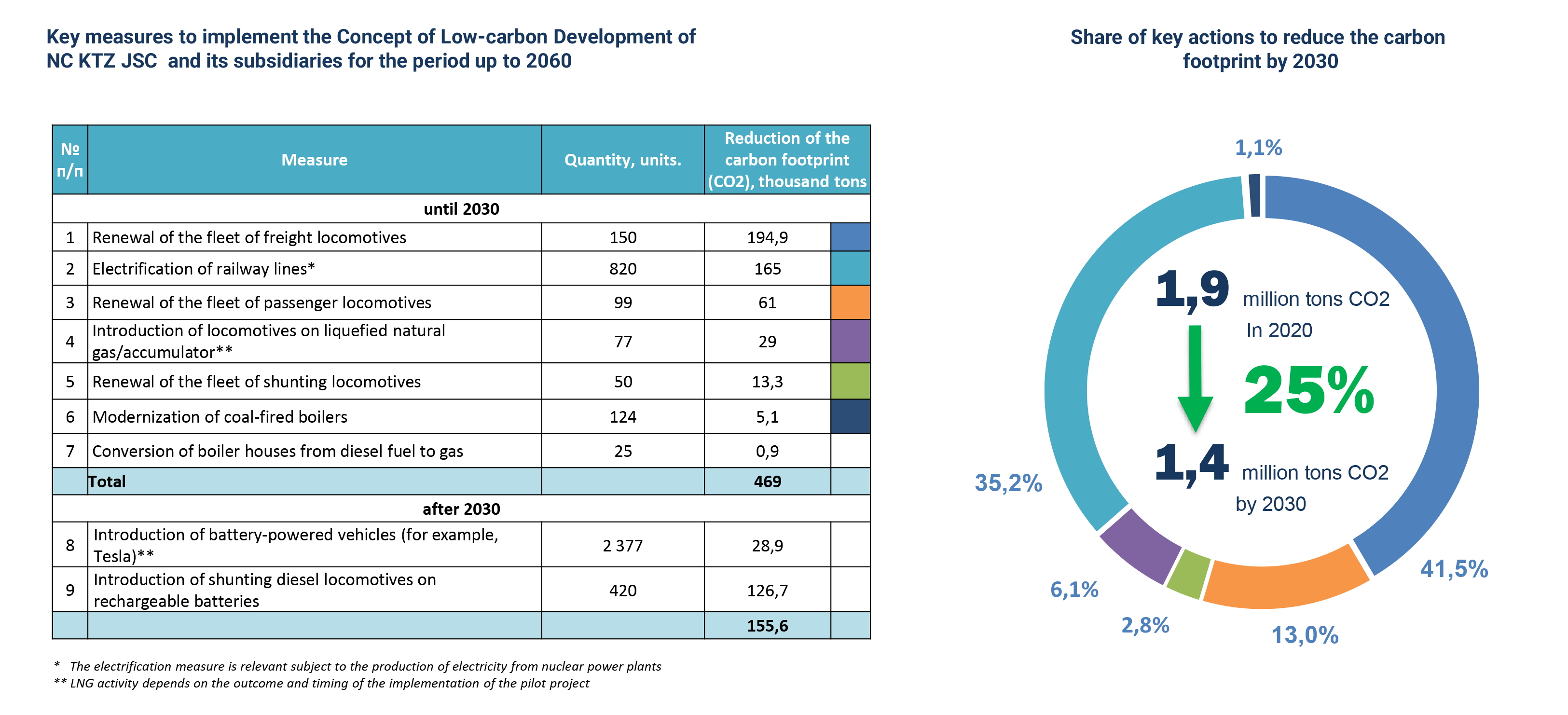
In 2022, the Management Board of the Company adopted the Concept of low-carbon development of NC KTZ JSC until 2060.
Approved by the decision of the Management Board of NC KTZ JSC dated December 26, 2022 (Minutes No. 02/49).
The concept of low-carbon development of NC KTZ JSC until 2060
Currently, NC KTZ JSC has developed a Concept of low-carbon development of NC KTZ JSC for the period up to 2060.
The goal of the Concept is to achieve carbon neutrality by the Company.
The priority objectives of the Concept are:
- defining the Company's goals and objectives to reduce its carbon footprint by 2060;
- determining the directions of technological development to achieve the goals of carbon neutrality;
- assessment of the need for investments and financial resources;
- assessment of key risks and consequences in case of non-fulfillment of the planned energy transfer goals.
The Company's carbon footprint includes direct and indirect emissions:
Dynamics of greenhouse gas emissions in the period from 2019-2025 (coverage area 1, 2), thousand tons of CO2-eq.

Structure of direct emissions by type of installation
From mobile sources: 94.7% (94.3% — railway fleet, 5.7% — vehicle fleet)
From stationary sources: 5.3%
Direct emissions of greenhouse gases are carried out during the operation of mobile sources (locomotives, railcars, cars) and stationary consumers (boilers, boiler houses, furnaces).
In 2025, the total volume of greenhouse gas emissions amounted to 5,236 thousand tons of CO₂-eq, including direct emissions (Scope 1) – 2,529 thousand tons and indirect emissions (Scope 2) – 2,707 thousand tons. Owing to the measures of the Low-Carbon Development Action Plan, specific Scope 1 CO₂ emissions per unit of traction work decreased by 2.07% compared to 2024 and by 7.6% compared to the base year 2021.
According to the Goals and Indicators of JSC NC KTZ in the field of occupational safety and health, ecology for 2026, approved by the Chief Engineer of JSC NC KTZ, a target has been set to reduce the carbon footprint (Scope 1 and 2) by 3% (see Goals and Indicators in the Field of Occupational Health and Safety, Ecology for 2026).
Rail transport is one of the most environmentally friendly modes of transport due to its efficient use of resources, lower emissions of harmful gases and low noise and vibration helps to improve air quality and reduce environmental impact.
Goals and Indicators in the Field of Occupational Health and Safety, Ecology for 2025
Electric locomotives using electric power are more environmentally friendly than diesel-powered locomotives. This is because they use energy more efficiently and do not produce harmful emissions.
Electric locomotives account for over 35% of the total number of locomotives, the data is presented in the table below.
The share of electric locomotives from the total number of locomotive fleet, %
|
Year |
The share of electric locomotives from the total number of locomotive fleet, % |
|
2019
|
32,3
|
|
2020
|
32,01
|
|
2021
|
30,8
|
|
2022
|
32,7
|
|
2023
|
32,5
|
|
2024
|
35
|
|
2025
|
36
|
Every year, the Company takes measures to reduce its carbon footprint. One of the important measures is the transition to new types of rolling stock, which helps to reduce greenhouse gas emissions. In particular, the Company is introducing EVOLUTION series locomotives, which emit 2.2 times less pollutants than older models.
Greenhouse gas emission targets within the framework of the Low-carbon Development Concept of NC KTZ JSC until 2060
As part of the implementation of the Concept's activities, it is planned to reduce direct emissions from 1.8 million tons of CO2 to 1.3 million tons, or by 25% of the 2020 level, until 2030. At the same time, in the absence of implementation of energy transfer measures, it increases by 16% due to an increase in diesel fuel consumption in train traction.
Dynamics of the carbon footprint (direct CO2 emissions), million tons